Monday, March 14, 2016

Rising Water: part 2
2 week progress report
           Over these couple weeks I have been doing a lot of research, reading articles, looking at graphs, and watching videos made by Nasa. I've learn that our sea levels are eventually going to rise rapidly, faster than we think. Around 2030 San Francisco may be flooded. There is a couple ways to stop this from happening. This is for people to start using less things that create pollution and in affect make green house gases. The other way to prevent this from happening is to build a levy or a super dam in the bay to stop the water from flowing  in the city. We actually have plans for the levy and super dams but that is more of a last resort plan. My next steps is to see if I can find someone in this field or area to give me some more information and give me some advice on what I should do to help this cause. I'm also planning to go out and complete some community service in order to set an example to my peers and spread awareness. Hopefully I can also get some of my friends to join in on the community service.

A video on the Arctic melting:

Sunday, March 6, 2016

Bird Beak Lab


In this lab we were asked the question, "How do changes in selective pressures affect the evolution of that species?" We found that through natural selection, and through different beaks, that the population changed to have significantly more spoon billed birds. Our data clearly showed that the spoon beaked bird had the most offspring. The spoon beaked bird had 26 offspring, the binder clip beak had 20 offspring, the tweezer beaked bird had 12 offspring, and the scissored beaked bird had 14 offspring.  The spoon billed beak made up 36% of the total offspring and the binder clip beak made up 27%, but non-the-less the spoon billed bird still had the most offspring. This data supports our claim because the trait of the spoon birds had extended through the population in such a short amount of time and the population had begun to look like them, or the "winners".

Some potential errors that we could have had would definitely be the variation in the amount of food. Obviously, some of the beaks were better suited to picking up different types of food. Some group had many rubber band seeds, and some had many macaroni seeds etc. For example, I found that picking up rubber band seeds and the macaroni seeds were most easy as I played the spoon billed bird. Our group in particular had many many rubber bands and that is partly why the spoon billed bird excelled in the kind of environment. Another potential error that we could have had could have been the amount of offspring produced per food. We had one offspring for every 5 pieces  of food that were collected, and the second time for every 10. This is not a real example of what would happen is the real ecosystem. 10 pieces of food does definitely not guarantee one a healthy offspring. There could have been a lot of variation, like the bird not being able to find a mate, or maybe the ecosystem was out of balance and there were to many predators.

This lab was done to demonstrate how natural selection and changes in the environment can affect the evolution and traits of a population. I learned from this lab that there are many different variables that help contribute to making just one offspring. Also, just one trait of a species chooses how successful they are in surviving. Based on my experience from this lab, I now know that evolution is really not such a complicated process. It is really just natural selection, and the kind of ecosystem.


Graph #1

                    Graph #2


Different kind of bird beaks


Friday, March 4, 2016

Rising Water
20 Time is a project made for students to take 20% of their class time and to spend it learning about something that interests them. Students have a chance explore what they are passionate about and love what they are learning about. The essential question that I asked was what can I do to make people more aware of global sea level rises. I, a student in Mr. Orre's, till the end of the school year, will work on raising awareness and learning about about sea level rises and global warming. I chose this idea to be the topic of my project because I find that this problem is growing and not much by authorities is being done to try and solve it. I'm not sure that many people know how serious this problem is, so my job is to point out facts and things that will happen if sea levels do rise, educate them on this rising problem. My goals are still being set, but it will try to go out and educate people locally. How? I'm still not sure, this also means that i'm not quite sure how I will measure my success. I'm going to move forward by deciding if i'm going to run a test and record my data that way. I'm also working on spotting a mentor to help me brainstorm ideas and out them to use.

Thursday, February 25, 2016

Unit 7 Reflection


The main topic about this unit was ecology, which is defined as the study of interactions between organisms and their environments. We learnt about the factors that take a big part in a certain ecosystem. The different levels and what would happen if one of them went out of balance. The way things were affected was by there different abiotic factors. Abiotic factors affect living organisms and the functioning of ecosystems. We looked the difference between a habitat and a niche. A habitat is where an organism lives, while a niche includes everything an organism needs to survive, such as food and water. One of the big ideas from this unit was interdependence. In other words interdependence means that all living things depend on each other, this is how balance is kept. This topic was presented when we delve into the topic of food webs and food chains, and how the size of different levels can affect each other.


In the conservation project each table group picked a ecosystem and set out to research about it. My group chose to do our project on the Arctic ecosystem. In this collaboration I felt frustrated most of the time because I had to keep pushing people to do work and carried an unevenly distributed amount of work. I felt this was unfair as I had taken on a bigger work load than my whole group. I ask my group to write 1/3 of the script we were going to use each. I wrote 1/3 of the script as well, but when editing the movie we made I found that my groups script did not fit the criteria that was asked. I was frustrated because I had to keeping pushing them to do their work. Since I agreed to taking on a bigger workload I expected them to complete there task given to them in a thorough fashion. Although I felt a strength of ours as a group being productive when shooting our video in class. At the end of this project/unit as a class we studied the kind of person we are. The best way you could behave would by being an assertive person. We took a test and I found myself to be an aggressive assertive person. In the future this information will help me to manage myself and my group better.

This is our conservation project on the Arctic:


Friday, February 5, 2016


Candy Electrophoresis Lab

None of our dyes had moved  in the wrong direction or mixed colors. The differences that had occurred between the reference dyes and the ones that we were testing there were that our red and orange were darker than the reference dyes, but for blue and yellow reference was darker than ours. However, I think this can be attributed to the amount of dye we extracted from the candy. 


I think that citrus blue 1 will move similar to red 2. Red 40 goes as fast as carminic acid. Yellow 6 goes as far as FCF. I think that yellow 5 should go as far as betanin. I chose this to be my hypothesis because although they may not be the same color and be the same size. The order of the dyes were random but stilled corresponded to betanin and the other reference dyes. Although the chemicals won't go as far as the dyes, they would order up.


Things like colored goldfish would probably contain food coloring to entice small kids into eating it. Most crackers does not contain food coloring and flavors. The company uses flavoring and colors so the kids eat it up.

I found all of those dyes in some cereal and sauces (tomato ketchup). I was surprised to find those dyes in my food and even found those done in the lab. I also found some natural color dyes annato extract color, and turmeric extract color. I learned that there are 7 dyes permitted in the US and I found most of them in my pantry at home.

There are  2 main factors that control the distance the dye travels is the dye's size, and how long you leave the gel in the electrophoresis box. I also think that the overall charge of the dye must also play a part in the direction it travels. I think this is by chance and can't be replicated exatly.

The force that moves the dye through the gel is the electromagnetic force. It sends a current through the gel and that is caused by the voltage .

The smaller dyes  traveled faster because of the holes that were in the gel. Smaller molecules move faster throughout the gel as they can fit through the holes easier.

I think that the gel should have been running so it would have been easier to see the difference in the lengths. Then we could see the DNA molecules of this size are so much larger than the dyes, I expect them not to travel as far. 

Tuesday, January 26, 2016

Extra Credit Bioethics Reading/Discussion 

           The technology that I researched is a jacket that North Face and a Japanese  named Spiber has created which is supposed to be made out of biotech spider silk. The jacket has been named the “moon parka’’ - a coat woven out of synthetic spider silk. This jacket seems really smart and cool but there can be a down side to a synthetic spider silk jacket. The biggest problem would be the fact that producing spider silk on an industrial level is not very efficient. You cannot build a factory that will produce spider silk.  Then there are the upsides - the spider silk the stretchiest and strongest natural material - great for sports. To make a second point, most sports wear is made out of polymer or some synthetic material. These are made in factories that require petroleum and pollute the earth. Whereas spider silk is produced in greenhouses where the spiders would be stored. Long story short this moon parka is environmentally friendly. But like I mentioned before the jacket would take a long time to make unless you has thousands upon thousands of greenhouses filled with spiders, so North Face and Spiber have come up with a solution to this problem. The spider protein which is called fibroin is generated by microbes. Spiber and North Face have isolated the gene responsible for making the protein and introduced it to bioengineered bacteria, meaning they churned it out as they grow. The protein collected is then made into to artificial silk. I like this idea and I think it could benefit many people and the earth. They have also found the solution to a problem and will soon start to produce and sell these jackets. I believe that the jacket would be great item to own, but a downside could be the fact the the selling price could be high and therefore not many people will be able to afford it.


Extra Website Citing’s:

Rhodes, Margaret. "The North Face’s ‘Moon Parka’ Is Spun From Faux Spider Silk." Wired.com. Conde Nast Digital, n.d. Web. 26 Jan. 2016. <http://www.wired.com/2015/12/the-north-faces-moon-parka-is-spun-from-faux-spider-silk/>.


Fischer, David. "The North Face's Moon Parka Is Made With Synthetic Spider Silk |       Highsnobiety." Highsnobiety. N.p., 23 Nov. 2015. Web. 26 Jan. 2016. <http://www.highsnobiety.com/2015/11/23/the-north-faces-moon-parka-is-made-with-synthetic-spider-silk/>.


Sunday, January 24, 2016

Unit 6 Reflection
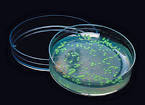
This unit was based of biotechnology. Biotech can be a big subject as it is two subjects combined. As a class we delve deep into the different categories of biotech and what they are used for. Biotech really makes a big foundation for life. For example, the industrial and environmental category of biotech focus on manmade foods. We also looked at biotech on a more molecular level. Looking at things like recombinant DNA and how we can grow bacteria that uses a protein called GFP to glow. In this unit we conducted 2 different labs. The first lab that we completed was called the electrophoresis lab this was when we extracted dyes from different types of candy and compared them to reference dyes. We put the dyes in to wells of some gel and sent an electromagnetic current through the gel. We did this to see which candies would match up to the reference dyes. The second ab that was conducted was called the pGLO lab. In this lab our objective was to grow bacteria so that it would glow just like jellyfish glow. My strengths in this unit were when we were talking about biotech as a whole and how it effects things. I also feel like I was good at understanding what the technologies and ethics of bio was. I found that when we talked about recombinant DNA, it was a big weakness for me and I fell out of the subject a little more. I want to learn more about bioethics and bio technologies. I took great interest in that and that is partly why I excelled in that area. Taking a look back at my SMART goals, I feel like I have improved on making a good habit for a study routine, but i'm not sure if this will benefit me. My problem is that I know what has been taught and I have practiced teaching it to others, but when applying my knowledge to tests I find it hard.