Thursday, February 25, 2016

Unit 7 Reflection


The main topic about this unit was ecology, which is defined as the study of interactions between organisms and their environments. We learnt about the factors that take a big part in a certain ecosystem. The different levels and what would happen if one of them went out of balance. The way things were affected was by there different abiotic factors. Abiotic factors affect living organisms and the functioning of ecosystems. We looked the difference between a habitat and a niche. A habitat is where an organism lives, while a niche includes everything an organism needs to survive, such as food and water. One of the big ideas from this unit was interdependence. In other words interdependence means that all living things depend on each other, this is how balance is kept. This topic was presented when we delve into the topic of food webs and food chains, and how the size of different levels can affect each other.


In the conservation project each table group picked a ecosystem and set out to research about it. My group chose to do our project on the Arctic ecosystem. In this collaboration I felt frustrated most of the time because I had to keep pushing people to do work and carried an unevenly distributed amount of work. I felt this was unfair as I had taken on a bigger work load than my whole group. I ask my group to write 1/3 of the script we were going to use each. I wrote 1/3 of the script as well, but when editing the movie we made I found that my groups script did not fit the criteria that was asked. I was frustrated because I had to keeping pushing them to do their work. Since I agreed to taking on a bigger workload I expected them to complete there task given to them in a thorough fashion. Although I felt a strength of ours as a group being productive when shooting our video in class. At the end of this project/unit as a class we studied the kind of person we are. The best way you could behave would by being an assertive person. We took a test and I found myself to be an aggressive assertive person. In the future this information will help me to manage myself and my group better.

This is our conservation project on the Arctic:


Friday, February 5, 2016


Candy Electrophoresis Lab

None of our dyes had moved  in the wrong direction or mixed colors. The differences that had occurred between the reference dyes and the ones that we were testing there were that our red and orange were darker than the reference dyes, but for blue and yellow reference was darker than ours. However, I think this can be attributed to the amount of dye we extracted from the candy. 


I think that citrus blue 1 will move similar to red 2. Red 40 goes as fast as carminic acid. Yellow 6 goes as far as FCF. I think that yellow 5 should go as far as betanin. I chose this to be my hypothesis because although they may not be the same color and be the same size. The order of the dyes were random but stilled corresponded to betanin and the other reference dyes. Although the chemicals won't go as far as the dyes, they would order up.


Things like colored goldfish would probably contain food coloring to entice small kids into eating it. Most crackers does not contain food coloring and flavors. The company uses flavoring and colors so the kids eat it up.

I found all of those dyes in some cereal and sauces (tomato ketchup). I was surprised to find those dyes in my food and even found those done in the lab. I also found some natural color dyes annato extract color, and turmeric extract color. I learned that there are 7 dyes permitted in the US and I found most of them in my pantry at home.

There are  2 main factors that control the distance the dye travels is the dye's size, and how long you leave the gel in the electrophoresis box. I also think that the overall charge of the dye must also play a part in the direction it travels. I think this is by chance and can't be replicated exatly.

The force that moves the dye through the gel is the electromagnetic force. It sends a current through the gel and that is caused by the voltage .

The smaller dyes  traveled faster because of the holes that were in the gel. Smaller molecules move faster throughout the gel as they can fit through the holes easier.

I think that the gel should have been running so it would have been easier to see the difference in the lengths. Then we could see the DNA molecules of this size are so much larger than the dyes, I expect them not to travel as far. 

Tuesday, January 26, 2016

Extra Credit Bioethics Reading/Discussion 

           The technology that I researched is a jacket that North Face and a Japanese  named Spiber has created which is supposed to be made out of biotech spider silk. The jacket has been named the “moon parka’’ - a coat woven out of synthetic spider silk. This jacket seems really smart and cool but there can be a down side to a synthetic spider silk jacket. The biggest problem would be the fact that producing spider silk on an industrial level is not very efficient. You cannot build a factory that will produce spider silk.  Then there are the upsides - the spider silk the stretchiest and strongest natural material - great for sports. To make a second point, most sports wear is made out of polymer or some synthetic material. These are made in factories that require petroleum and pollute the earth. Whereas spider silk is produced in greenhouses where the spiders would be stored. Long story short this moon parka is environmentally friendly. But like I mentioned before the jacket would take a long time to make unless you has thousands upon thousands of greenhouses filled with spiders, so North Face and Spiber have come up with a solution to this problem. The spider protein which is called fibroin is generated by microbes. Spiber and North Face have isolated the gene responsible for making the protein and introduced it to bioengineered bacteria, meaning they churned it out as they grow. The protein collected is then made into to artificial silk. I like this idea and I think it could benefit many people and the earth. They have also found the solution to a problem and will soon start to produce and sell these jackets. I believe that the jacket would be great item to own, but a downside could be the fact the the selling price could be high and therefore not many people will be able to afford it.


Extra Website Citing’s:

Rhodes, Margaret. "The North Face’s ‘Moon Parka’ Is Spun From Faux Spider Silk." Wired.com. Conde Nast Digital, n.d. Web. 26 Jan. 2016. <http://www.wired.com/2015/12/the-north-faces-moon-parka-is-spun-from-faux-spider-silk/>.


Fischer, David. "The North Face's Moon Parka Is Made With Synthetic Spider Silk |       Highsnobiety." Highsnobiety. N.p., 23 Nov. 2015. Web. 26 Jan. 2016. <http://www.highsnobiety.com/2015/11/23/the-north-faces-moon-parka-is-made-with-synthetic-spider-silk/>.


Sunday, January 24, 2016

Unit 6 Reflection
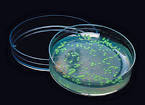
This unit was based of biotechnology. Biotech can be a big subject as it is two subjects combined. As a class we delve deep into the different categories of biotech and what they are used for. Biotech really makes a big foundation for life. For example, the industrial and environmental category of biotech focus on manmade foods. We also looked at biotech on a more molecular level. Looking at things like recombinant DNA and how we can grow bacteria that uses a protein called GFP to glow. In this unit we conducted 2 different labs. The first lab that we completed was called the electrophoresis lab this was when we extracted dyes from different types of candy and compared them to reference dyes. We put the dyes in to wells of some gel and sent an electromagnetic current through the gel. We did this to see which candies would match up to the reference dyes. The second ab that was conducted was called the pGLO lab. In this lab our objective was to grow bacteria so that it would glow just like jellyfish glow. My strengths in this unit were when we were talking about biotech as a whole and how it effects things. I also feel like I was good at understanding what the technologies and ethics of bio was. I found that when we talked about recombinant DNA, it was a big weakness for me and I fell out of the subject a little more. I want to learn more about bioethics and bio technologies. I took great interest in that and that is partly why I excelled in that area. Taking a look back at my SMART goals, I feel like I have improved on making a good habit for a study routine, but i'm not sure if this will benefit me. My problem is that I know what has been taught and I have practiced teaching it to others, but when applying my knowledge to tests I find it hard.


Friday, January 22, 2016

pGLO Lab


Two new traits in the bacteria consist of glowing green colonies and ampicillan.

The amount of bacteria that would be in -pGLO LB would be none. The amount for bacteria that would appear in -pGLO LB/Amp is none. The last to are different though as +pGLO LB/Amp would produce around 448 colonies and +pGLO LB/Amp/ara would produce 640 colonies.

The role that the arabinose played was that it attaches to the promoter and then triggers the glowing.


GFP is used in mice. They tried it in mice to test if they can get the florescent look they get in jellyfish an found that the mice glowed everywhere but its hair. They also tried it in plants to test if they were freezer resistant, if the plant glows you know that the plant is freezer resistant. They have even made fish with GFP in it. These fish glow and are actually sold to people. The fact that the fish glows will appeal more to a certain demographic, kids.

An example of another application of genetic engineering would be to figure out if people are related. So for example you can take their genetics and compare them to each other.


Thursday, January 14, 2016

Thinking Like a Biotechnician 

Today we conducted a lab that showed the imitation and the process of inserting plasmid into a bacteria plasmid. Our plasmid had a resistance to ampicllin. As part of this lab we were told to find a restriction enzyme then cut a segment out of the DNA and cut the plasmid open. The enzyme used was closest to an insulin gene. We used an enzyme that was closest to the insulin gene. My group then combined the DNA and plasmid with Ligase. We used tape to represent the Ligase. If we had used kanamycin or tetracycline as our resistance it would have kill our bacteria, so in order to test if bacteria took our plasmid, we used ampicllin because our plasmid has a natural resistance to it and if the bacteria survived then the insertion would be successful. The enzyme restriction that we used to cut the DNA segment was called Hin III. We used Hin III because it cut the the human gene in two places and cut the plasmid in only one 1 place. The reason for this criteria is because if the restriction enzyme cut the bacteria in more than one place, then the lyase would not know where to attach the insulin gene to. This is important in every day life, because it is used to create many known antibiotics and show, so that we can test and use these products. This technology can also be used today to create longer lasting foods or help kill viruses.


Monday, January 4, 2016

SMART Goals
In this new semester of Biology I would like to make a SMART goal that can better improve my performance in the class. I am motivated to come up with better study skills and routines. I will work towards practicing how to study and then put the skills into action. My action plan will be to practice study skills for 10-15 mins every time I complete a vodcast. I will study the content of the vodcast I just completed using the given study tips by Mr. Orre last semester.

I would also to present another SMART goal which is not biology related. This goal has to do with reaching out to friends. I find that sometimes my friends feel frustrated with me because I do not reach out to them outside of school. I will when time isn't of the essence, call or text a friend and ask them if they would like to hang outside of school.